Solenco Air Purifier Purification Pal
Description
Air Purifier for your baby
Designed with babies in mind, the Solenco Air Purification Pal will improve the air quality in your baby’s nursery. It quietly reduces airborne dust, pollen, pet dander and odours, creating a calm, fresher-feeling space for naps and bedtime.
Even the cleanest home can have polluted air – cleaning materials, carpets and upholstered fabrics, pets and nearby traffic can all impact indoor air quality. In fact, indoor air can be five times as polluted as outdoor air and, since indoor air is not circulated as much as outdoor air, many airborne pollutants thrive inside.
Solenco Air Purifiers for a fresher nursery at bedtime
This is where the Solenco Air Purification Pal’s four stage purification system comes into play. It traps up to 99.975% of particles, allergens, pollen, dust, smoke, mould spores and pet dander. It also reduces VOCs (volatile organic compounds, which can be 10 times more concentrated indoors compared to outdoors), fumes and odours, and includes a built-in UV-C lamp.
Beyond cleaner air, with its soft night light and cute interchangeable stickers, compact design and low noise output, the Solenco Air Purification Pal is perfect for your baby’s nursery.
Technical Specifications
| For nurseries | 10m2 @ 4 air cycles/hour |
| Noise level | 24 – 48 dB (quieter than your electric toothbrush) |
| Power supply | 230V/50Hz (a normal plug-point) |
| Power consumption | 30-45W |
| CADR | 85m3/h |
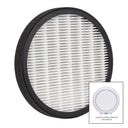
| Replacement Filter | Find it here. |
| Air flow | 83m3/hour (ample for an average-sized room) |
| CADR rating | 92m3/hour (53.7cfm) (the clean air delivery rate measures an air purifier’s effectiveness in removing different particle sizes) |
| Filters | 3-in-1: Pre filter, carbon and H13 HEPA (able to trap up to 99.975% of particles, allergens, pollen, dust, smoke, mould spores and pet dander) |
| Filter lifespan | 4320 Hours |
| UV-C | Built-in UV-C lamp |
| UV light wavelengths | 254 nanometres |
| UV-C lamp | 20,000 hours (4 years @ 12 hours/day) |
| Dimensions & weight | 259mm x 179mm x 265mm; 2.5kg (ultra-light and easy to move) |
| Fan Speed | Four |
| Sleep mode | Yes |
| Warranty | 24 Months |
| Timer | 2/4/8-hour |
How Air Purifiers Work & FAQs
How Does an Air Purifier Work?
Air purifiers continuously draw in air from the surrounding environment, pass it through multiple filters, and release cleaner, fresher air back into the room. The HEPA filter captures up to 99.975% of microscopic pollutants such as dust, pollen, pet dander and mould spores. The activated carbon filter absorbs odours and VOCs (volatile organic compounds), and the unit also includes a UV-C lamp. This process runs constantly, ensuring ongoing purification rather than an instant, one-time result.
How Often Should the Air Pass Through the Filter?
For optimal air cleaning, the air in a room should circulate through the purifier’s filters around 4 to 5 times per hour. This rate, known as the Air Changes Per Hour (ACH), depends on the purifier’s power and the room size. For example, a room measuring 20m² will be purified faster at a higher fan speed than a larger open-plan area. If the fan speed is too low or the room is too large, you might not notice an immediate difference.
Does Fan Speed Matter?
Yes — the higher the fan speed, the faster the air passes through the filters and the quicker pollutants are captured. During periods of high pollution (like when cooking, cleaning, or when pollen counts are high), it’s best to run your purifier at a medium to high setting. Use sleep mode for quieter nighttime operation when air quality is generally more stable.
Why Might I Not Notice a Difference Right Away?
Air purification is a continuous process, and the results can be subtle over short periods. Smells and airborne pollutants build up over time, and depending on airflow, room size, and how well the space is sealed from outdoor air, it can take several hours for noticeable improvement. Keep windows and doors closed for best results, especially if your home is close to traffic or outdoor pollution sources.
What Affects Air Purifier Performance?
- Room Size: Ensure your purifier’s rated coverage (e.g. 30m² or 60m²) matches your space.
- Fan Speed: Faster speeds clean air more quickly.
- Air Circulation: Position the purifier away from walls or corners for better airflow.
- External Influence: Open windows or constant door traffic can introduce new pollutants continuously.
- Filter Maintenance: A clogged filter reduces effectiveness — check regularly and replace as indicated.
How Can I Tell If My Air Purifier Is Working?
- Airflow: You should feel clean air blowing from the outlet when the unit is running.
- Filter Check: Over time, filters will gradually darken as they capture particles — this is normal and shows it’s working.
- Air Quality Monitors: If you use a PM2.5 monitor, you should see the particle count drop after the purifier has been operating for a while.
- Reduced Dust and Smells: After consistent use (a few hours or days), you should notice less dust on surfaces and reduced lingering odours.
Final Note: Air Purification Is Continuous
It’s important to remember that air purification is an ongoing process. Just like your fridge continuously keeps food cold, your air purifier keeps the air clean by running regularly. Leaving it on throughout the day, especially on auto mode, ensures consistent air quality and maximum benefit for your family.
What you'll need over time
-
Replacement Filter Solenco Air Purification Pal- Baby Brilliance
Every 6–12 months